
Pokémon TCG scanner · collection tracker
Scan a card.
Know what it is worth.
Watch the collection add up.
Point your camera at a card and Cardient identifies it — set and number — pulls its market value, with every printing priced separately, and builds a living portfolio of everything you own.
No account, ever. Your collection lives on your phone, and the photo you scan is used to identify the card and is not kept.
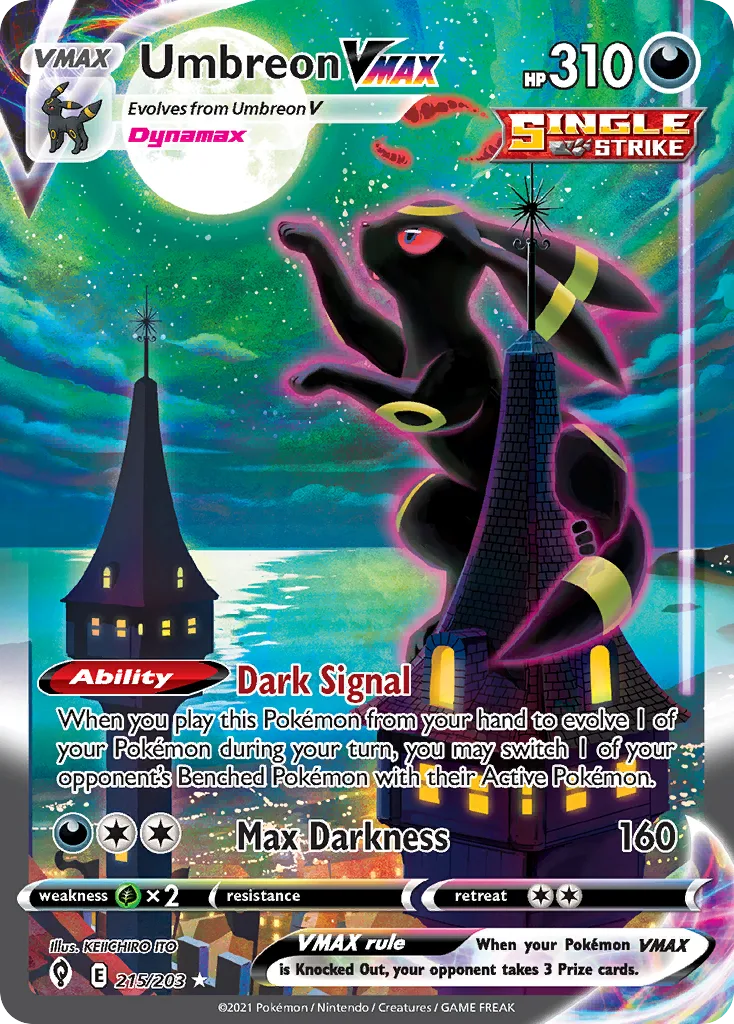
Scan · Identify · Value · Collect
Scan
Frame the card inside the guide. A level indicator tells you when the camera is square to it.
Identify
AI vision reads the whole card — art, set symbol, collector number — not just the text on it.
Value
Market price for each printing. Holo, reverse holo and alt art stay separate.
Collect
Add it to your collection and the portfolio total moves with it.
What it does
A scanner, a price check and a collection, in the same three seconds.
Identification
Scans in about a second.
Cardient recognises the card from the picture, across the whole Pokémon catalogue — English and Japanese sets alike. It reads the art, not just the name, so near-identical reprints do not get confused for each other.
Scanning needs a connection: the crop of the card is sent to our identification service, matched, and not kept. Nothing stores the image.
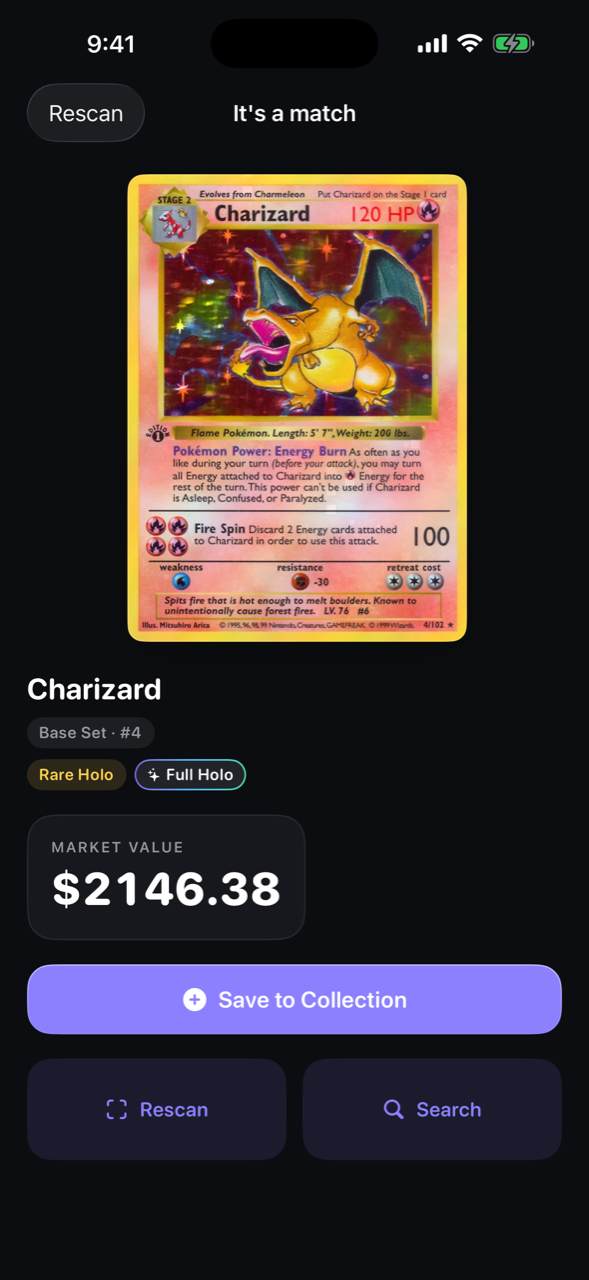
Pricing
Prices you can actually trust.
Every printing of a card has its own market value. A reverse holo is not priced as the base card, an alt art is not priced as the set it sits in, and a first edition is its own line. Getting this wrong is the single most common complaint about the apps already on the store.
Values are estimates from third-party market data, for collection management — not an offer to buy or sell.
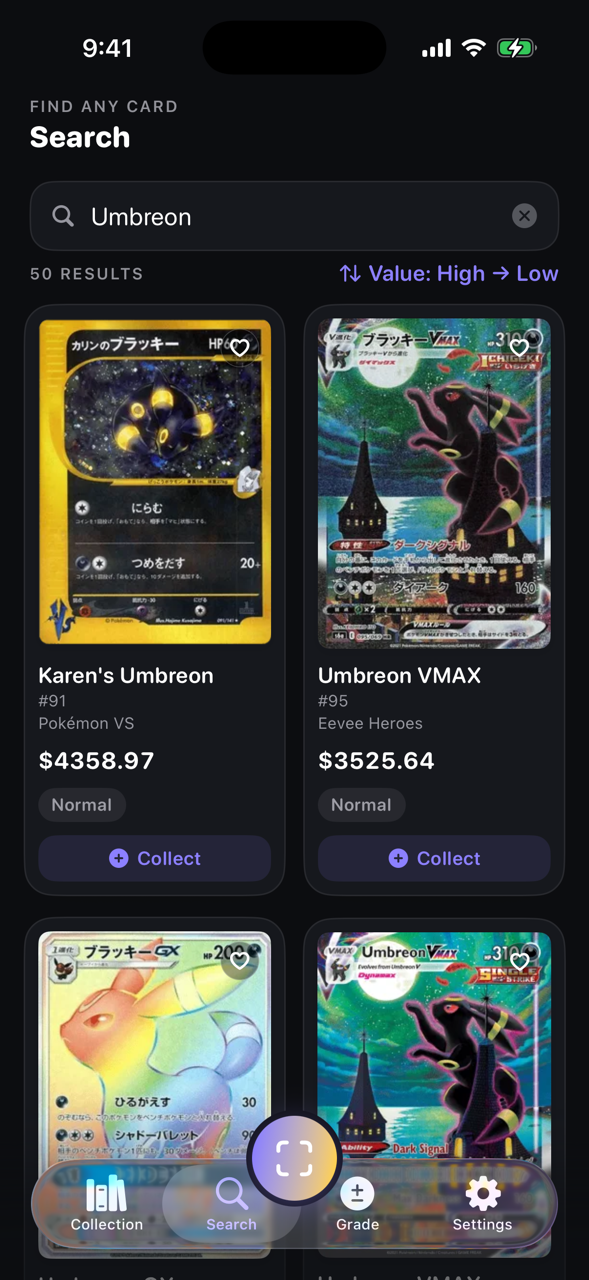
Collection
Your collection becomes a portfolio.
Total value, and gain and loss over time. The binder you already own, with a number attached to it — which turns out to be the reason people open the app on a day they are not buying anything.
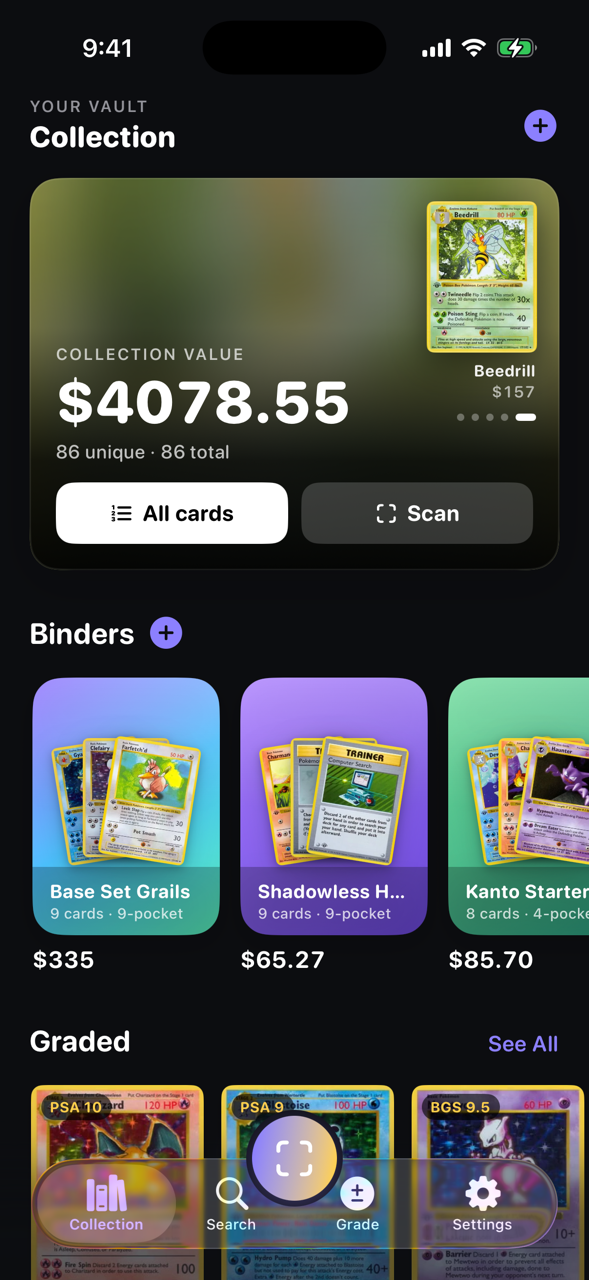
Sets
See how close a set is to done.
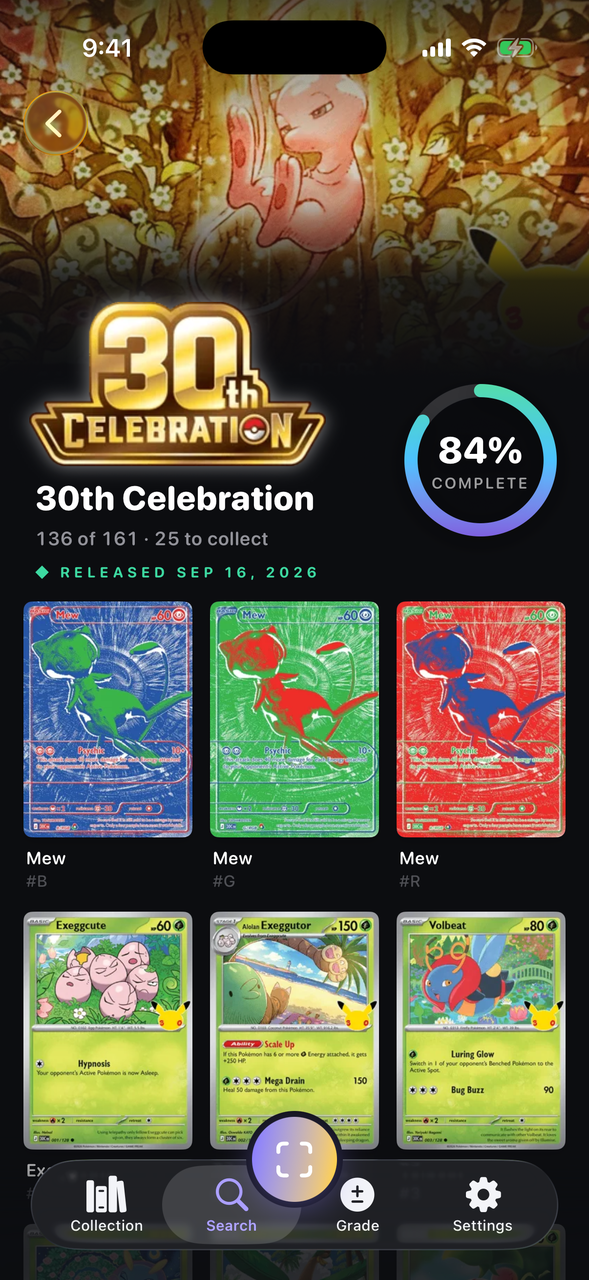
Every set you touch gets a completion ring, a count of what is left, and the release date — over the set's own artwork. The missing cards are the point: you can see the 25 you still need rather than the 136 you already have.
Home screen
The cards you love, on your home screen.
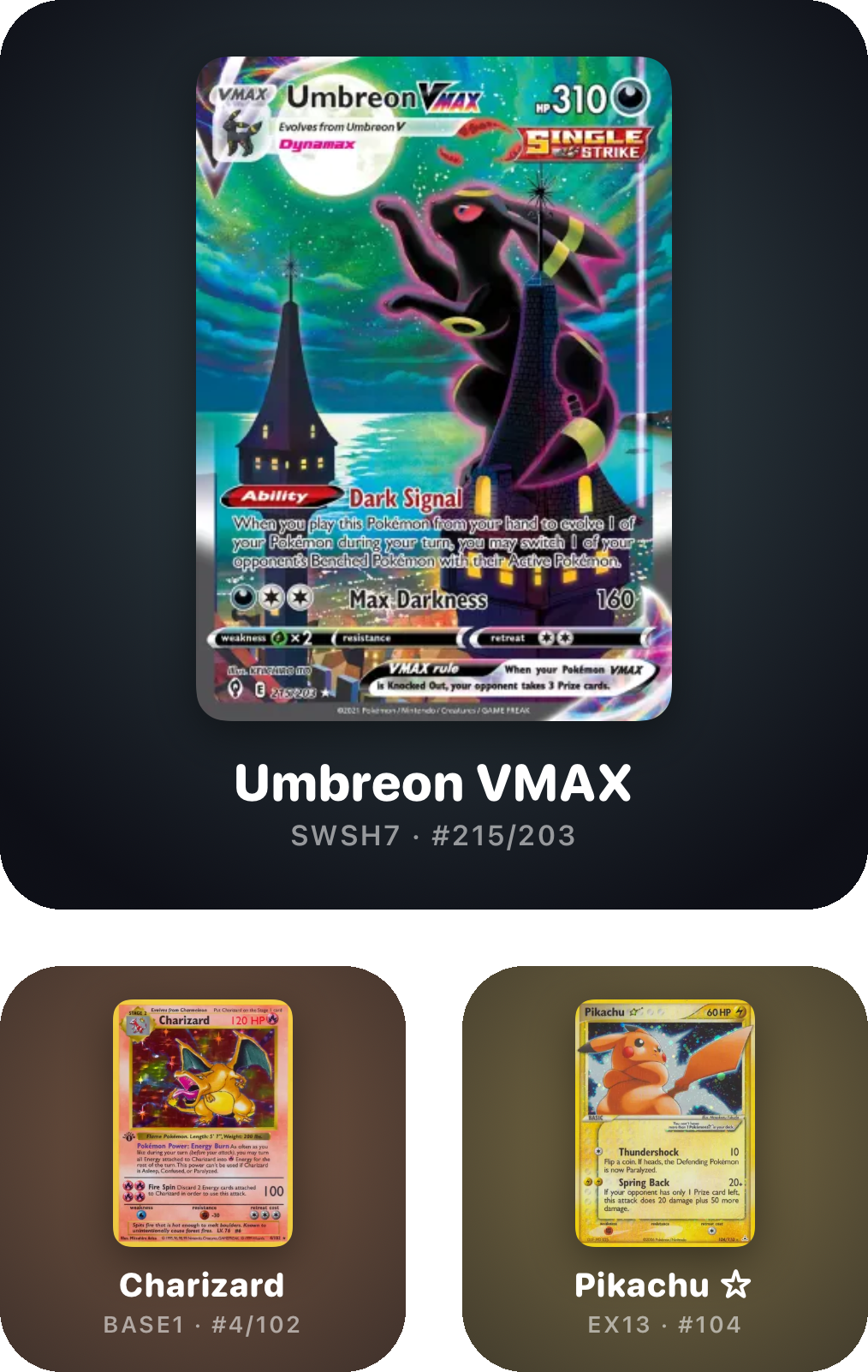
Your favourite cards take turns on your home screen, each floating over a glow drawn from its own artwork. Small or large, as many as you like — the cards you are proudest of, where you already look a hundred times a day.
Favourites
Keep a list of the ones you are chasing.
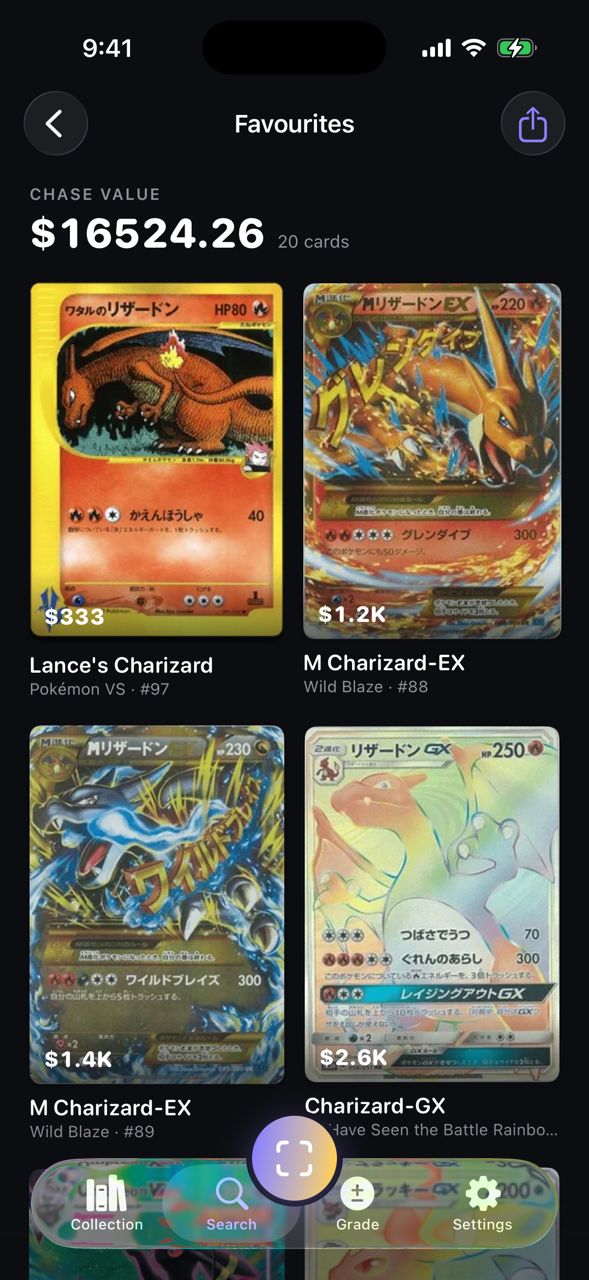
Heart anything you do not own yet and it lands in Favourites — a wall of the cards you are chasing, each with its value beside it and its set and collector number — so you buy the right printing rather than one that looks like it. Free — not a Pro feature, not a trial.
Grade
Know before you grade.
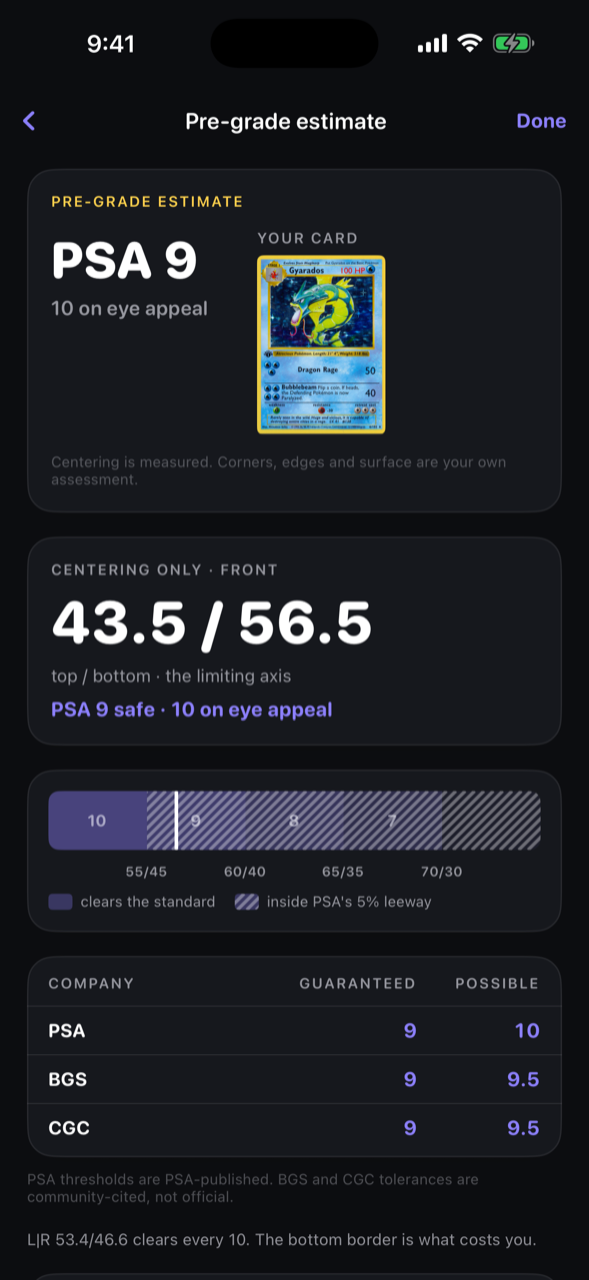
Centering is the usual reason a card misses a 10, and it is measurable before you spend anything. Cardient straightens the card for perspective first, so the measurement is of the card and not of your camera angle, then measures the borders on both faces.
Then it does the part nobody else can: it puts that number against what the card is worth Raw, at PSA 9 and at PSA 10, and tells you plainly whether submitting is worth the fee. Raw, graded and population sit behind one tap, so you can see how many copies already hold the grade you are aiming at.
- Perspective-corrected before measuring — the number is not inherited from the camera angle.
- An 18× loupe while you drag the guides, so you are placing them on a border you can see.
- A live level indicator at capture, in degrees.
- It refuses to state a grade it cannot know. It separates what is guaranteed from what is possible.
Measuring centering is free and unlimited. Pro unlocks the money answer — the Raw → PSA 9 → PSA 10 value ladder.
Why Cardient and not one of the others.
Every printing priced on its own
Variants are the whole game in this hobby and the apps that conflate them are wrong about the price by an order of magnitude. Cardient keeps them apart.
No account, ever
No sign-up, no email, no password, no profile. You open the app and it works. Your collection is yours, on your device.
An answer, not just a number
Centering apps give you a percentage. Cardient tells you what that percentage is worth, because it is the only one that also knows what the card sells for graded.
English and Japanese, properly
Japanese sets are in the catalogue as first-class entries, not bolted onto an English set list — so a Japanese card resolves to its own printing instead of to whatever English card happens to share its number.
Built for the dark
Dark from the first screen, quiet chrome, and card art as the loudest thing on it. Prices use fixed-width figures so they do not jitter when they update.
Measure before you pay to grade
Centering is the usual reason a card misses the grade, and it is the one factor you can settle at home for nothing. Cardient corrects for camera angle first, so the number is the card's and not your camera's.
Pricing
Free is genuinely useful. Pro is for the people who scan a lot.
What Pro costs — and any introductory offer running at the time — is shown in the App Store and on the paywall inside the app, in your own currency. We do not quote it here, because it differs by country and we would rather it be right than convenient.
Free
no account, nothing to sign up for
- Unlimited manual card search
- Free card scans every day
- Market value for any card
- Your whole collection, viewable offline
- Favourites
- Centering measurement — unlimited
Cardient Pro
a subscription, bought through Apple
- Scan without the daily limit
- Full portfolio analytics — gain and loss, set completion
- Price history charts
- PSA and graded prices, with the population report behind them
- The Raw → PSA 9 → PSA 10 worth-submitting verdict
- Collection backup, restorable on the same device
- Subscriptions are bought and managed in the app through Apple. Nothing is sold on this website.
- Cancel any time in iOS Settings → your name → Subscriptions.
Questions people actually ask.
Is Cardient free?
Yes. The free tier gives you unlimited manual card search, free card scans every day, market values, your collection, favourites, and unlimited centering measurement. Search and browsing do not use your scans. Cardient Pro lifts the daily scan limit and adds the portfolio analytics, price history, graded prices with the population report, and the worth-submitting verdict.
Does Cardient upload my card photos?
Yes, and here is exactly what happens. When you scan, the cropped picture of the card is sent to our identification service so the card can be recognised. It is used for that one request and is not kept — it is not written to storage, not attached to you, and not used to train anything. Scanning therefore needs a network connection.
Is it safe to use a Pokémon card scanner?
That depends entirely on which one, and there are three things worth checking: what it does with your photo, what it knows about you, and what it keeps. For Cardient — there is no account, so there is no name, email or password of yours to lose in the first place. The cropped picture of the card is sent to be identified and is not kept; nothing on our side stores it. If you import a photo rather than taking one, iOS runs the picker outside the app and hands Cardient only the single image you chose, so it never gets access to your photo library. Your collection is stored on your device.
Do I need an account?
No, and there is no way to make one. Cardient has no sign-up, no email, no password. That is a deliberate design decision rather than a missing feature. The trade-off is real and worth stating: with no account there is nothing to sync, so your collection lives on the device you built it on.
How accurate are the prices?
Values come from third-party market data, and each printing of a card has its own value: holo, reverse holo, alt art and first-edition versions are priced separately rather than collapsed into one number. They are estimates of recent market activity for collection management, not a quote, and actual sale prices differ.
What cards does Cardient support?
The Pokémon Trading Card Game, across English and Japanese sets. Other trading card games are not supported in v1.
Does Cardient work offline?
Your collection, its totals and anything already saved are available offline. Scanning and fetching fresh prices need a connection, because identification happens on our servers.
Can Cardient tell me whether a card is worth grading?
It measures the centering on both faces after correcting for camera perspective, then compares what the card is worth raw against what it is worth at PSA 9 and PSA 10, and gives you a plain answer on whether the submission fee makes sense. It will not claim to predict a grader's decision — it tells you what it can actually know.
Does Cardient work on iPad?
Yes. Cardient is a universal app for iPhone and iPad.
How do I cancel Cardient Pro?
Subscriptions are managed by Apple. Go to iOS Settings, tap your name, then Subscriptions, then Cardient, and tap Cancel Subscription. You keep Pro until the end of the period you have already paid for.
Anything else — help@lamigsoftware.com.
Point your camera at the first card.
No sign-up, no email, nothing to create. Open it and scan.